
Your cart is empty. Let's change that!
Shop our productsOops! Something went wrong while submitting the form.
.webp)
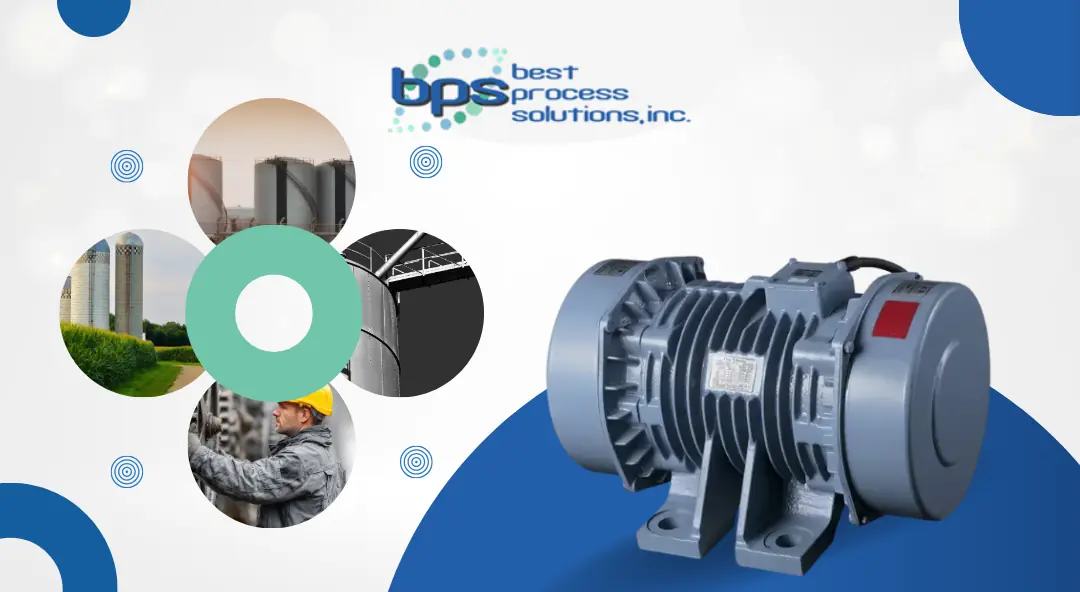
Bridging and ratholing waste storage capacity, starve downstream equipment, and turn routine discharge into a manual intervention nightmare. Here's how to prevent both - starting with the physics, then the hardware.
If you've ever walked past a silo and heard someone banging on the walls with a sledgehammer, you already know the problem. Material isn't flowing. The level indicator says the bin is full, but the feeder below is starving. Production stops while a crew climbs up to rod out the blockage or pound the hopper cone until something breaks loose.
That's bridging and ratholing at work. They're the two most common flow failures in bulk storage, and they cost plants far more than most people track - in lost production, wasted material, damaged equipment, and safety incidents from manual clearing. The good news: both problems are preventable with the right combination of silo geometry, vibration-based flow aids, and properly matched discharge equipment.
Bridging (also called arching) happens when bulk material forms a stable, self-supporting arch across the silo outlet or hopper opening. Everything above the arch is held up. Nothing flows. It's a complete blockage that requires intervention to break.
Bridges form two ways. Mechanical interlocking occurs when large or irregularly shaped particles wedge together across an opening. Cohesive bridging occurs when fine, moist, or sticky particles bond together under the pressure of the material column above them, forming an arch strong enough to support its own weight plus the load on top.
Ratholing (also called channeling or piping) happens when material discharges only through a narrow vertical channel directly above the outlet. The rest of the material stays packed against the silo walls, unmoved. The silo looks full on level sensors, but the effective capacity is a fraction of the total volume.
Over time, the stagnant material in a rathole degrades. It cakes, hardens, absorbs moisture from the environment, and becomes even harder to move. What started as a flow pattern problem becomes a structural and product quality problem.
Bridging and ratholing aren't random failures. They're predictable outcomes when material properties and silo geometry combine in the wrong way.
Material factors that increase the risk:
Silo geometry factors:
Understanding why bulk density matters in material handling is fundamental here. Cohesive materials with low bulk density are the most prone to bridging because gravity has the least advantage against the cohesive forces holding the arch together.
The single most important factor in preventing bridging and ratholing is the flow pattern inside the silo during discharge.
| Characteristic | Mass Flow | Funnel Flow |
|---|---|---|
| Material motion | All material moves whenever any is withdrawn | Only material directly above outlet moves; rest is stagnant |
| Ratholing risk | None - no stagnant zones possible | High - stagnant material forms stable ratholes |
| Bridging risk | Low - outlet sized to prevent arching | High - narrow outlet and shallow angles promote arches |
| First-in, first-out | Yes - oldest material discharges first | No - oldest material stays on walls indefinitely |
| Hopper requirements | Steep walls, low-friction surface, larger outlet | Less steep, smaller outlet acceptable for free-flowing materials |
| Best for | Cohesive, fine, or moisture-sensitive materials | Free-flowing granular materials only |
If you're storing cohesive material in a funnel flow silo, you're going to have flow problems. The question isn't if - it's when and how bad. Retrofitting a funnel flow silo for improved flow is possible but requires a combination of steeper internal cones, low-friction liners, enlarged outlets, and vibration-based flow aids.
When silo geometry alone doesn't prevent flow problems, external flow aids step in. The three main categories each work differently:
Vibrators (pneumatic piston, rotary electric, or electromagnetic) mount externally on the hopper wall or cone and transmit controlled vibration into the material. They break cohesive bonds between particles and between particles and walls, promoting flow without compacting the material further - when sized and positioned correctly. Air piston vibrators are a common choice for silo and hopper applications because they deliver high-force, low-frequency impacts that are effective on cohesive materials.
Air cannons store compressed air and release it in a single powerful blast through a nozzle aimed into the silo. They're effective at breaking established blockages but work reactively rather than preventively. Poorly placed cannons can compact material or create new dead zones.
Fluidizers (air pads, aeration nozzles) inject low-pressure air into the material to reduce interparticle friction. They work well for fine, dry powders but are less effective on coarse, wet, or fibrous materials. They also require clean, dry compressed air supply.
Vibration works by momentarily reducing the interparticle friction and cohesive strength of the bulk material. When a vibrator fires on the hopper cone, the energy propagates through the material near the wall, breaking the bond between particles and between particles and the wall surface. Gravity then takes over and the material flows.
The key parameters for effective silo vibration are:
For operations that need air-powered systems in hazardous or remote locations where electric power isn't practical, pneumatic vibrators are the standard choice. They run on plant air, tolerate dusty and wet environments, and require minimal maintenance.
If your silos are bridging or ratholing and you need to size the right vibrator or feeder for the application, talk to our team. We can help match the flow aid to your material, silo geometry, and discharge requirements.
Most discussions about bridging and ratholing focus on the silo. But the feeder below the outlet plays an equally important role.
A feeder that doesn't draw material evenly across the full outlet width creates preferential flow channels. That's a rathole in the making. A feeder that can't keep pace with the available discharge rate causes material to sit and consolidate above it, increasing the risk of bridging.
Vibratory feeders are one of the better choices for silo discharge because they provide controllable, uniform withdrawal across the outlet width. Options include:
The feeder needs to be sized so its capacity exceeds the required discharge rate, and its tray width matches or exceeds the silo outlet width. A narrow feeder under a wide outlet guarantees uneven draw and eventual ratholing. For deeper guidance on feeder selection, see our article on choosing the right motor for your vibratory feeder.
For a broader look at common design mistakes in vibratory systems, we've covered additional pitfalls in a separate guide.
When a silo stops flowing, work through this checklist before reaching for the sledgehammer:
Keeping daily vibratory equipment checklists current helps catch degradation before it becomes a full blockage.
Different industries store different materials, and each has its own bridging and ratholing personality.
Chemical powders: Fine, cohesive, often hygroscopic. Temperature sensitivity is common. Low-frequency vibration plus fluidization aeration often provides the best results. Enclosed vibratory feeders protect against dust and contamination at the discharge point.
Mining ores and aggregates: Coarse and abrasive, but moisture from wet processing can make fines sticky enough to bridge. Heavy-duty industrial vibrating motors on robust hopper structures handle the forces involved. See our guide on increasing ore throughput with heavy-duty vibratory equipment.
Food ingredients: Sanitary design is mandatory. Stainless steel construction, crevice-free surfaces, and food-grade lubricants on all vibrators. Sugar, flour, and spice blends are among the worst bridging offenders due to fine particle size and moisture sensitivity.
Concrete and cement: Cement is one of the classic bridging materials. It's fine, cohesive, and time-consolidates aggressively. Cement silos almost always require active flow aids and properly designed mass flow or expanded flow discharge sections.
Recycling streams: Mixed and unpredictable. Plastic flakes, shredded paper, glass cullet, and commingled streams each behave differently. The variability itself is the challenge - what flows today may bridge tomorrow with a different incoming load.
If your operation needs equipment that keeps material moving without adding headaches to the maintenance schedule, start a conversation. Explore our bulk processing equipment, check our bulk density guide for material characterization, or contact us directly. We'll help you size the right solution for your operation.
Bridging is an arch-shaped blockage that forms above the silo outlet and stops all flow. Ratholing is a narrow flow channel through stagnant material - discharge continues, but only through a fraction of the silo's cross section, wasting storage capacity and leaving material to degrade on the walls.
For most silo and hopper applications, pneumatic piston vibrators deliver the right combination of high force and low frequency to break cohesive bridges. They mount externally on the hopper cone, tolerate dusty environments, and run on plant air. Electric rotary vibrators are a good alternative where continuous operation and energy efficiency matter more.
On the hopper cone, near the outlet where bridges form. Mounting on the cylindrical section above the transition wastes energy because the vibration doesn't reach the critical zone. The vibrator should be positioned so its force propagates directly into the material column above the outlet.
Often, yes. Adding properly sized and positioned vibrators, enlarging the outlet opening, installing low-friction liners, and matching the right feeder below the silo can solve flow problems without a full silo redesign. The best approach depends on the severity of the problem and the material involved.
Variable flow behavior almost always traces back to changes in material properties, especially moisture content. Seasonal humidity, rain exposure during transport, upstream process changes, or different batches from a supplier can all shift the material into bridging territory. Measuring and controlling moisture is the most impactful single action.
Vibration helps but doesn't eliminate ratholing by itself. Ratholing is a flow pattern problem caused by funnel flow. Vibrators on the hopper cone can break wall adhesion and promote wider draw, but the fundamental fix for ratholing is converting to mass flow discharge - steeper walls, lower friction, and a larger outlet.
No. Hammering damages the silo structure, can cause sudden material release onto workers below, and rarely fixes the underlying problem. If manual intervention is needed, air lances or properly positioned air cannons are safer alternatives. The long-term fix is preventing the blockage from forming in the first place.
Here are some common questions. Please contact us if you have a question we didn't answer.


.webp)
Copyright © Best Process Solutions
Website built by Peak Search