
Your cart is empty. Let's change that!
Shop our productsOops! Something went wrong while submitting the form.
.webp)
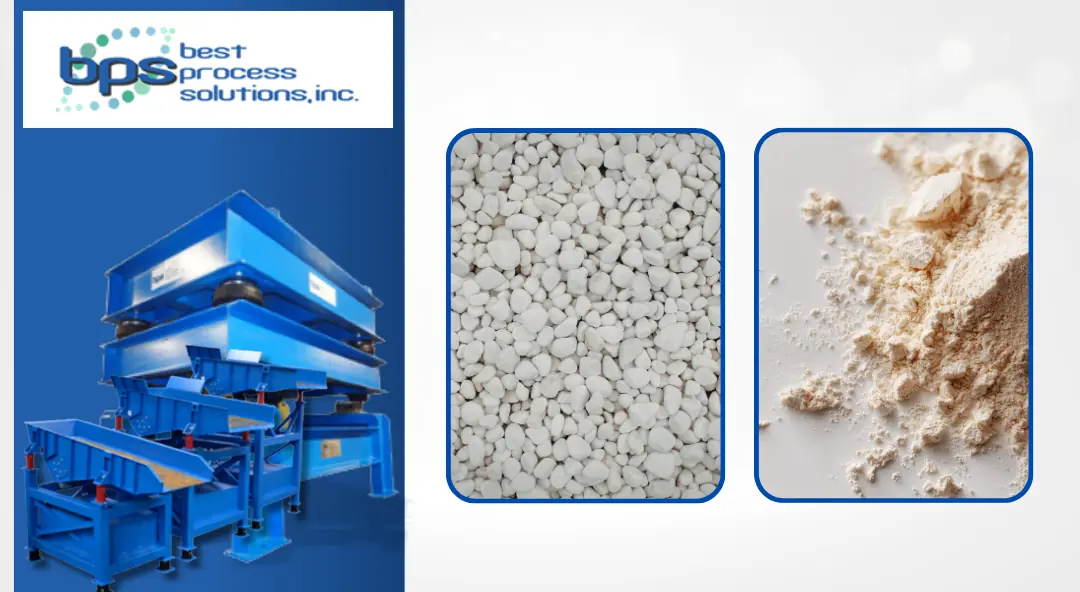
Particle size distribution is one of those process inputs that quietly runs the whole show. It drives flow behavior, segregation, and screening efficiency, which means it also drives tons per hour, downtime, and how often your crew has to break out a bar and a shop vac.
When particle sizes swing too wide, bulk systems tend to get unpredictable. Flow goes from smooth to lumpy, screens stop separating cleanly, and minor variability turns into hidden costs you only notice after a few months of extra maintenance and missed targets.
Best Process Solutions (BPS) builds vibratory feeders and screening systems that help keep throughput consistent across diverse particle sizes so your process runs steadier and your ROI shows up in fewer disruptions, less rework, and cleaner separation.
Particle size distribution is a core operating parameter for granular materials. It directly affects flow characteristics, segregation behavior, and screening performance.
If the distribution is inconsistent, bulk processing operations feel it fast. Large variations in particle size can create erratic flow properties that drive segregation. That turns into blockages, unstable feed rates, and reduced throughput.
Poor particle size distribution also ties into poor blending and can reduce packing density in products.
Reliable equipment helps here. BPS systems are designed to support consistent flow and separation so bulk processing systems run more predictably.
In bulk processing, particle size distribution drives flowability, segregation, and how hard your equipment has to work to do the same job.
In more specialized applications, it can also impact powder bed behavior and additive manufacturing processes. Knowing what particle size distribution is doing in your system makes it easier to manage risk from poor flow and keep processes predictable.
Uniform throughput is easier to hold when particle size distribution is consistent. Uniform sizing supports steady flow, reduces bottlenecks, and helps equipment run in its intended window.
One common tool for evaluating flowability is the Hausner ratio.
Hausner ratio = tapped density / apparent density
Ways operators use these metrics to support consistent throughput include sieving to standardize particle sizes, using automated vibratory feeders to stabilize feed rate, and calibrating process parameters so daily operation stays in range.
If you are tuning a line for more stable flow, the BPS blog How BPS Equipment Maximizes Material Flow with Frequency and Amplitude is a useful companion reference.
Bottom line: size and shape interact. If you manage one and ignore the other, you usually still end up chasing variability.
Particle size variability is a common reason screening performance falls off. In bulk material handling, non-uniform particles can lead to blockages, incomplete separation, lower throughput, and lower product quality.
If you are selecting or troubleshooting a screening setup, start with Vibratory Screeners for Bulk Processing and, for mixed streams, Vibratory Screeners for Recycling.
Sieve analysis works well for coarser materials and is commonly used for particles greater than 50 μm. For finer powders, air elutriation is often a better fit and is commonly paired with laser diffraction methods.
Method
Where it fits best
Practical payoff
Sieve analysis
Coarser material, typically > 50 μm
Low cost, clear fractions for QC
Air elutriation
Fine powders, often paired with laser diffraction
Non-destructive, higher resolution, avoids sieve compaction effects
If you are seeing repeated stops or inconsistent separation, compare the symptoms to related BPS troubleshooting posts like Common Causes of Vibratory Feeder Failures and How to Fix Them and Replacing Springs, Motors, and Key Components in Vibratory Machines.
Segregation happens when different particle sizes separate during handling. That separation drives quality variability downstream.
Preventative measures often include reducing drop heights, smoothing transfer paths, and tuning feeders so the system does not surge. For process design considerations, Multi-Stage Vibratory Systems is a relevant reference.
Non-uniform particle sizes are a common cause of production delays and unplanned downtime. Inconsistencies often start upstream, but the downstream impacts show up as screen overloads, feeder instability, and recirculation loads.
Uncontrolled particle sizes often show up as hidden costs, especially energy and maintenance costs. Wider size spreads can drive uneven material buildup, clog filters, increase wear, and force more frequent cleanouts.
BPS equipment supports consistent handling across a wide range of particle sizes with advanced vibratory feeders and screening systems designed for control. Reduced variability in particle distribution helps plants run steadier, waste less, and spend less time recovering from process upsets.
Advanced vibratory feeders and screening systems from BPS help control particle movement, improving separation and flow in challenging environments.
For equipment options that support consistent feed and clean separation, review Pan Feeders, Electromagnetic Vibratory Feeder, Twin Screw Vibratory Feeder, and Vibratory Tube Feeder.
Different materials behave differently. Coarse aggregate does not move like fine powder, and neither behaves like a blend that wants to segregate. BPS builds solutions around material-specific assessments so processing parameters can be tuned for the material profile.
If you are working in an application area, also review the related industry pages for mining, recycling, chemical, food processing, and concrete.
For calibration and tuning background, see Calibration Methods for Consistent Vibratory Performance and Foundations of Vibratory Equipment Tuning.
Particle size management works best when it is treated like any other critical process variable. A practical workflow includes establishing baseline conditions, monitoring key metrics, and adjusting process parameters so flow and separation stay stable.
BPS methods and equipment are used across industries where particle size control drives efficiency. Common examples include pharmaceuticals, food processing, chemical manufacturing, mining, recycling, and construction materials.
Industry
Example efficiency gain
Typical sizing or control approach
Pharma
Cost reduction from tighter size control
Laser diffraction and process monitoring
Food
Waste reduction and improved consistency
Process control and screening
Chemicals
Yield improvement through optimized particle sizing
Controlled feed rates and screening
Optimizing particle size distribution can improve ROI by reducing flow problems, segregation, and process inefficiencies. Treat particle size distribution as a control variable, not a background detail.
If you want to stabilize throughput and reduce the hidden costs tied to variability, it is worth a direct conversation with BPS about application-specific solutions.
Here are some common questions. Please contact us if you have a question we didn't answer.


.webp)